
Hashimotos Nutrition in Barnsley
Personalised Nutrition for Hashimoto’s
Contact Our Team Today
We aim to get back to you in 24 hours.
Being diagnosed with Hashimoto’s can make food suddenly feel complicated. Search for nutrition advice and you’ll quickly find recommendations to remove gluten, avoid dairy, take selenium, increase iodine or follow a strict autoimmune diet.
But Hashimoto’s doesn’t come with one universally recommended diet.
Hashimoto’s thyroiditis is an autoimmune condition in which the immune system attacks thyroid cells and can eventually lead to an underactive thyroid.
Our Hashimoto’s nutrition support in Barnsley focuses on eating well alongside appropriate thyroid treatment, without creating restrictions that don’t have a clear purpose.
Contact Our Team Today
You’ve Been Diagnosed. What Happens to Your Diet?
For many people, surprisingly little needs to change immediately.
There are no specific foods or supplements recommended to treat a thyroid disorder. The British Thyroid Foundation instead advises eating a balanced diet containing an appropriate variety of foods.
That gives us a useful starting point.
Rather than handing every client in Barnsley a Hashimoto’s food list, we can look at what you already eat.
Are your meals varied?
Are you getting regular sources of protein and fibre?
Have you already cut out several foods?
Are supplements beginning to replace ordinary food?
And, importantly, are you taking thyroid medication in a way that supports consistent absorption?
Hashimoto’s + Levothyroxine
If Hashimoto’s has caused hypothyroidism, you may be prescribed levothyroxine to replace the thyroid hormone your body isn’t producing sufficiently.
This is where food becomes relevant in a very practical way.
Levothyroxine is generally taken on an empty stomach, 30–60 minutes before breakfast, caffeine or other medicines. Iron and calcium supplements can interfere with it, while the British Thyroid Foundation also highlights soya as a consideration around absorption.
For someone receiving Hashimoto’s nutrition support in Barnsley, sorting out that routine can sometimes be more worthwhile than changing the foods on the plate.
Get in touch with a specialist
The Gluten Question
This deserves its own section because it's one of the first things people with Hashimoto’s tend to encounter online.
Having Hashimoto’s does not automatically mean you need a gluten-free diet.
There is, however, an association between autoimmune thyroid disease and coeliac disease. The British Thyroid Foundation reports that around 1.5–3.8% of people with autoimmune thyroid disease also have coeliac disease, compared with around 1% of the general population, and notes NICE guidance that people with autoimmune thyroid disease should be offered coeliac testing at diagnosis.
If you have coeliac disease, the situation is different: gluten must be removed.
If you don't, automatically eliminating bread, pasta and other gluten-containing foods isn't the default Hashimoto’s treatment.
If you've already gone gluten-free in Barnsley, we can review what you're eating instead and make sure the restriction hasn't unnecessarily reduced the quality or variety of your diet.
Don't Try to “Boost” Your Thyroid With Iodine
This is another area where thyroid nutrition can become counterintuitive.
Your thyroid needs iodine to make thyroid hormones, so taking extra iodine might sound helpful.
For somebody with an existing thyroid condition, it can be the opposite.
The British Thyroid Foundation advises against iodine and kelp supplements because they may contain excessive or variable amounts of iodine that can worsen existing thyroid conditions.
A low-iodine diet isn't routinely required either. In the UK, this is primarily used temporarily around particular radioactive iodine treatment for thyroid cancer when instructed by the medical team.
So our Hashimoto’s nutrition plans in Barnsley don't involve simply adding or removing iodine.
What About Selenium?
Selenium receives plenty of attention because it's involved in normal thyroid hormone metabolism.
That doesn't mean everybody with Hashimoto’s should start taking high-dose selenium.
The British Thyroid Foundation advises caution around supplementation and notes that there is no specific food or supplement that can be used to treat a thyroid disorder.
Instead of building your plan around individual nutrients, we can first look at whether you're eating a varied diet and whether there's a genuine reason to consider supplementation.
A Hashimoto’s Diet Can Still Look Like Normal Food
This is perhaps the most reassuring part.
Breakfast doesn't need to become a thyroid smoothie.
Lunch doesn't need to contain six “anti-inflammatory” ingredients.
Dinner doesn't need to exclude half the supermarket.
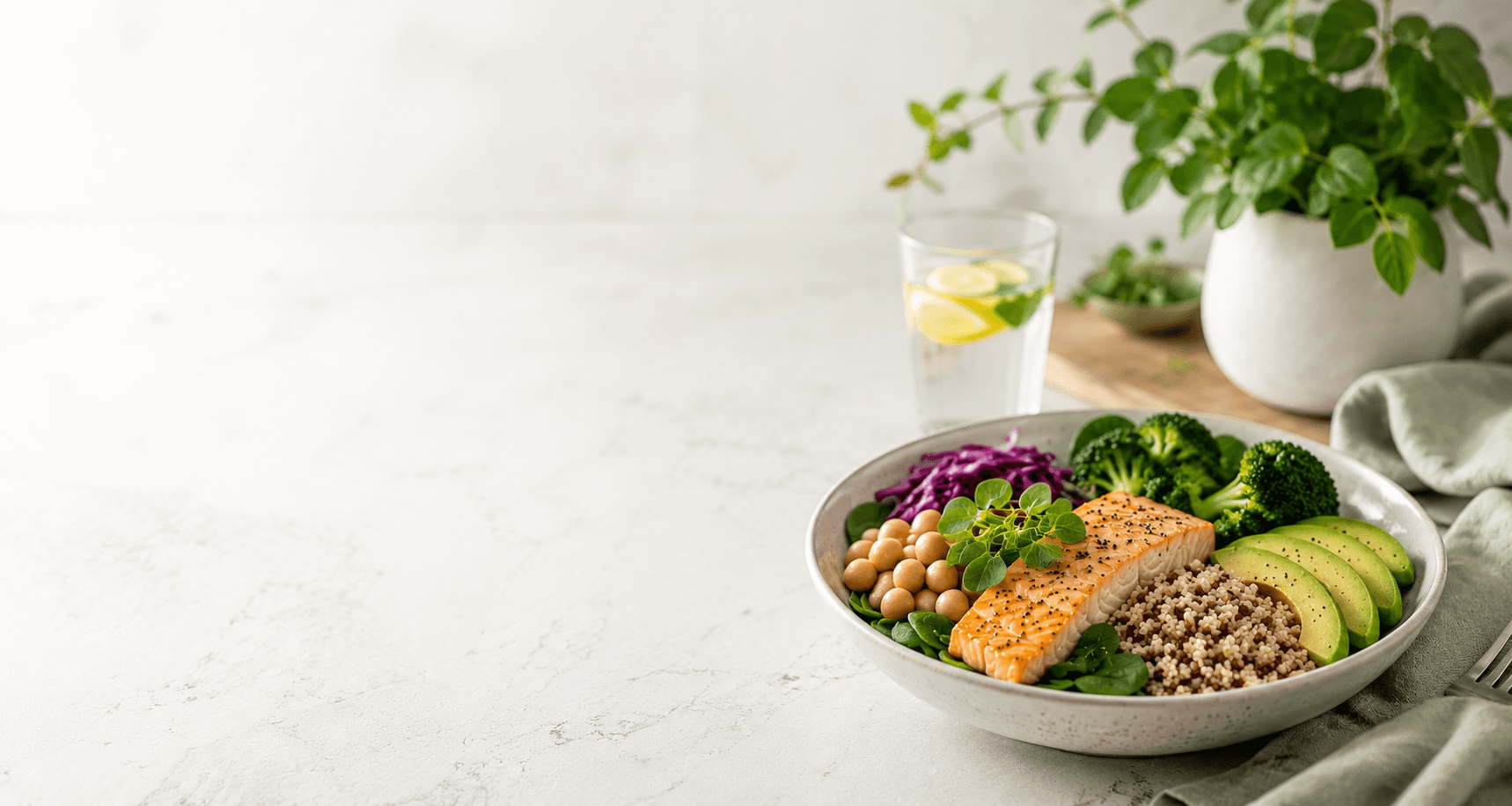
Your everyday diet can still include vegetables, fruit, potatoes, rice, pasta, wholegrains, beans, pulses, fish, eggs, meat, dairy or alternatives, nuts and seeds according to your needs and preferences.
The British Thyroid Foundation recommends this kind of varied, balanced approach for people living with thyroid disorders.
For clients in Barnsley, we'll usually work with familiar meals first and improve them where necessary.
When Hashimoto’s Advice Has Taken Over Your Diet
Sometimes people come to us after trying everything.
Gluten-free. Dairy-free. No soya. No nightshades. No brassica vegetables. Multiple supplements every morning.
At that point, the most useful nutrition intervention may be simplification.
Normal amounts of broccoli, cabbage, cauliflower and kale aren't generally considered a concern in the UK; the British Thyroid Foundation says consumption would need to be very high before brassicas become a realistic thyroid issue.
Your Hashimoto’s nutrition support in Barnsley can therefore include reviewing the rules you've accumulated and separating necessary restrictions from ones that may no longer be helping you.
Food Supports Your Health — It Doesn't Replace Treatment
Hashimoto’s is an autoimmune thyroid condition, not something that can responsibly be promised to “heal” through diet.
Where it causes hypothyroidism, medical monitoring and thyroid hormone replacement may be required.
Nutrition has a different role.
It can help you maintain a balanced diet, understand medication-food interactions, avoid inappropriate supplements and make sure unnecessary restrictions aren't making eating harder than it needs to be.
Online Hashimoto’s nutrition support is available throughout Barnsley and surrounding areas.
If you're looking for a clearer way to approach Hashimoto’s nutrition in Barnsley, we'll start with your current diet and work out what actually deserves changing.
speak with our team today
What People are Saying About Us
★★★★★
"I feel much less overwhelmed by Hashimoto's nutrition than I did before."
Lauren V.
Yorkshire
★★★★★
"The focus on dietary balance rather than elimination was really refreshing."
Samantha B.
Yorkshire
★★★★★
"I now understand what I should prioritise instead of constantly changing my diet."
Jessica H.
Yorkshire
★★★★★
"Clear, personalised advice that made food feel simpler again."
Claire M.
Yorkshire
Our Locations
Looking for our services in another area in South Yorkshire? We are proud to work nationally across the UK, allowing us to ensure we can provide our specialist Hashimotos Nutrition services to you.
For a full list of locations we cover in South Yorkshire, see below.